
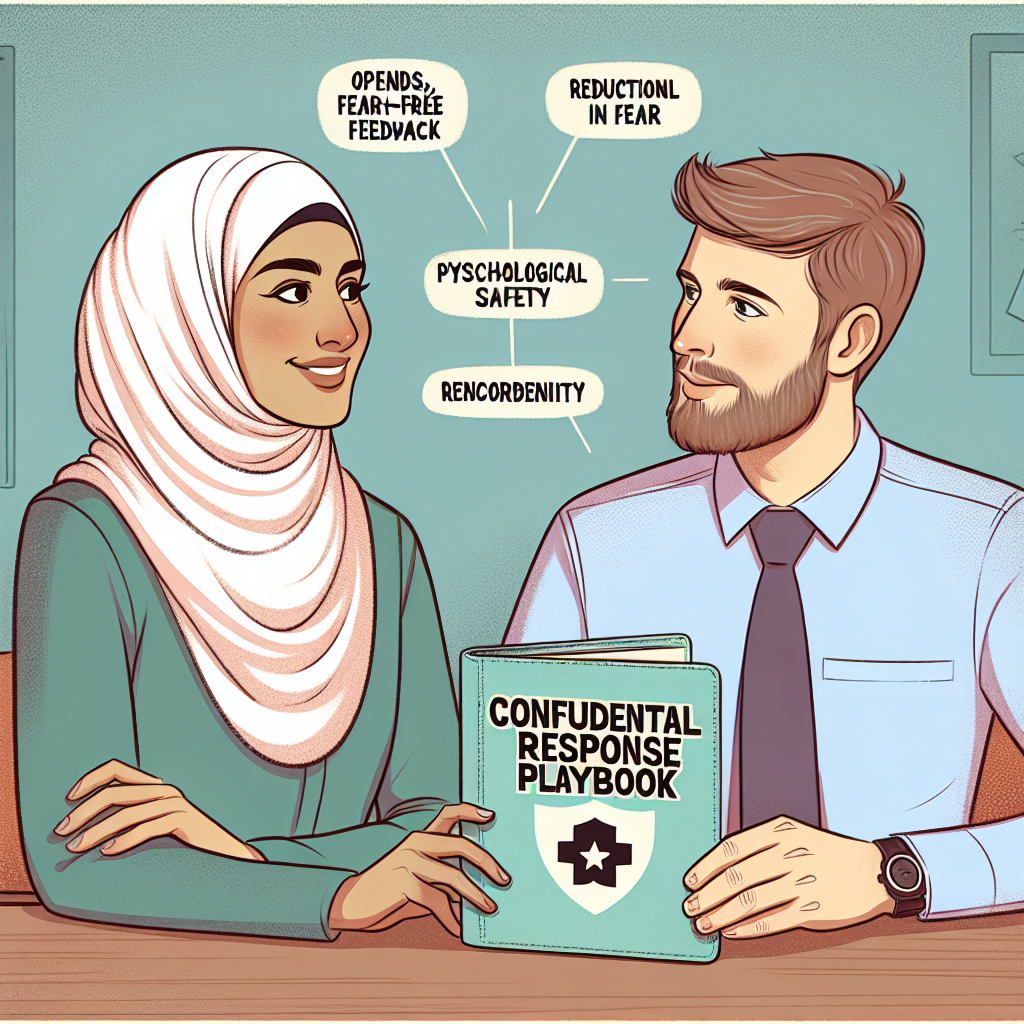
Many teams want honest, timely feedback, but fear of reprisal or embarrassment often shuts conversations down. Creating a culture of psychological safety matters: when people feel safe they speak up, innovate, and correct errors. Intent alone isn’t enough—without clear practices, open feedback can be performative or risky. This piece lays out realistic ways to reduce fear so feedback stays candid and constructive.
We introduce practical response playbooks: short, repeatable scripts and norms for receiving, documenting, and acting on input. Combined with simple confidentiality measures, role-aware prompts, and clear escalation paths, these playbooks help teams turn anxiety into actionable improvement. Read on for conversational, respectful steps to design playbooks that protect trust, normalize learning, and make open feedback reliably safe and useful.
Foundation and purpose
Start here to understand why predictable responses matter. This section defines core terms, explores the common sources of fear that block useful input, and highlights what teams gain when they adopt clear response playbooks.
Intro: the case for open feedback
Success looks like timely, candid observations shared directly between colleagues—not just polite performance reviews. Below are concise definitions and a short rationale grounded in practice and research.
Open feedback refers to timely, candid observations about work behavior, product risks, or process breakdowns shared between colleagues. A response playbook is a compact set of steps—scripts, documentation rules, and escalation paths—used when giving or receiving that input. Together they reduce ambiguity and make interactions predictable.
Evidence indicates that teams with explicit norms communicate more effectively under pressure. Organizations that prioritize psychological safety show higher innovation and lower error recurrence, as noted by sources such as re:Work with Google and Amy Edmondson’s research. The practical takeaway: clarity in how feedback is handled increases the chance it will be offered and acted upon.
Problem and context: fear, confidentiality concerns, and blocked feedback
Here we examine common barriers to speaking up and point to where compact playbooks can intervene. Expect concrete examples and a short process you can adopt.
Fear typically stems from three predictable sources: perceived reputational risk, uncertainty about who will see the feedback, and power dynamics between roles. If people expect feedback to be used against them—or if past reports went unanswered—they stop reporting near-misses and poor decisions.
Confidentiality concerns intensify that reticence. While anonymity can increase reporting volume, it may also reduce trust in outcomes; equally, fully public forums can chill contributors. A balanced approach uses defined confidentiality levels, a named reviewer where appropriate, and an agreed timeline for outcomes.
Numbered process — a minimal playbook for receiving feedback safely:
- Acknowledge quickly: thank the sender and confirm receipt.
- Clarify: ask one question to remove ambiguity (who, when, impact).
- Log with the assigned confidentiality level and reviewer.
- Decide on immediate steps and who owns the follow-up.
- Follow up within the agreed timeline and close the loop publicly or privately per the confidentiality rule.
Brief do/don’t list:
- Do name an owner for each piece of feedback.
- Do document expected timelines and outcomes.
- Don’t promise anonymity if escalation is likely to require disclosure.
- Don’t leave feedback unresolved—ambiguity breeds mistrust.
“Feedback is the breakfast of champions.” — Ken Blanchard
Benefits: psychological safety, learning speed, and better decisions
Reducing fear and making responses predictable yields measurable team benefits. Below are the main outcomes and practical signals to watch for.
Improved psychological safety correlates with faster learning cycles and more robust decisions because errors surface earlier and are less likely to recur. Teams that systematize response behaviors convert anecdotes into data, enabling trend analysis and targeted interventions.
Concrete benefits include shorter time-to-fix, fewer recurring incidents, and better employee retention. Measuring these changes makes progress visible and helps refine the playbook language so responses remain predictable, fair, and trusted.
Put policy into practice
Good intentions often stall when a difficult conversation arrives. This section translates principles into concrete, low-friction steps teams can adopt immediately: practical playbooks, training habits, and safeguards that reduce risk without adding bureaucracy.
Response playbooks: what they are and how they reduce fear
In short, playbooks convert vague norms into a predictable sequence of actions people can follow under stress. The explanation below clarifies the mechanism and why it matters.
A response playbook combines a compact script with a lightweight workflow—who hears the input, the confidentiality level, and the next three actions. Predictability removes the main source of paralysis: uncertainty about consequences. Clear escalation paths and known follow-up responsibilities reduce perceived reputational risk and lower barriers to speaking up.
Research on team dynamics shows that process clarity complements psychological safety. For more on structured norms and speaking up, see Amy Edmondson’s work in the Harvard Business Review. In practice, playbooks help leaders fix systems rather than just addressing individual mistakes.
Implementation steps — seven practical actions
Follow these seven actionable, low-friction steps in order, adapting language and timing to your team’s context.
1. Establish clear confidentiality rules and expectations
Define a small set of confidentiality levels (for example, Public, Team-only, Reviewer-only) and when each applies. Publish examples so contributors understand the limits of implied anonymity.
Key practice: always name the reviewer for non-anonymous reports and state when escalation will require disclosure.
2. Co-create norms and feedback language with teams
Invite representatives to draft the playbook wording so templates feel familiar and non-threatening. Co-creation builds buy-in and surfaces power dynamics early.
Keep phrases short and neutral (for example, “I observed X; here’s the impact; I’m suggesting Y”). Those templates reduce ad-lib risk and emotional escalation.
3. Build and distribute role-based response playbooks
Create slightly different scripts for peers, managers, and incident reviewers. Role-aware wording clarifies responsibilities—who acknowledges, who documents, and who decides.
Store playbooks in a shared location and attach them to relevant meeting agendas so they become routine reference items.
4. Train with role-play to normalize responses and reduce anxiety
Run short, low-stakes rehearsals where participants practice receiving and logging feedback using the scripts. Role-play demystifies the first awkward interactions.
Repeat exercises quarterly and include follow-ups where participants reflect on what felt safe and what didn’t.
5. Integrate feedback rituals into meetings and 1:1s
Adopt a one-line ritual—for example, “one thing that worked / one thing to change”—and allow private flagging for sensitive items. Rituals lower the cognitive load of giving feedback.
Monitor usage to ensure voices are broad, not concentrated among a few people.
6. Offer safe channels and optional anonymity
Provide at least two channels: identified submission and optional anonymity. Communicate trade-offs clearly: anonymity may increase volume but can limit follow-up.
Operational rule: anonymous reports should trigger a named reviewer and a public, redacted summary of findings.
7. Review, iterate, and close the feedback loop with metrics
Set short review cycles (30–60 days) to evaluate outcomes and adjust wording. Visible closure reinforces that input leads to action.
Publish a brief monthly update summarizing trends while preserving confidentiality.
Challenges & mitigations: addressing trust, power dynamics, and confidentiality lapses
Playbooks reduce risk but don’t eliminate problems. Below are common failure modes and practical mitigations you can apply.
When trust is low, increase transparency about outcomes without breaching confidentiality. If power dynamics silence contributors, require upward feedback in anonymized form and rotate reviewers to reduce retaliation risk. For confidentiality lapses, enact a clear remediation process: acknowledge the mistake, own the error publicly where appropriate, and update rules to prevent repeats.
“Clear processes create confidence; without them people guess—and guessing breeds fear.” — Amy Edmondson
Measurement & metrics: tracking fear reduction and feedback health
Metrics make qualitative improvements verifiable. Focus on a compact set that aligns with your playbook goals and use the results to guide small, continuous adjustments.
- Frequency of candid inputs: actionable reports per month.
- Time-to-resolution: median days from report to documented decision.
- Confidentiality incidents: number of breaches per quarter.
- Closure rate: percent of reports closed within agreed timeline.
- Perceived safety: pulse score on whether people feel safe to speak up.
Review these metrics in regular retrospectives to decide small changes to wording, channels, or ownership.
Example / case pattern: applying a response playbook in a project retrospective
The following numbered process shows the playbook in action during a retrospective and demonstrates how predictable steps reduce anxiety and produce outcomes.
- Acknowledge — facilitator thanks the reporter and states the confidentiality level.
- Clarify — one clarifying question to pin down impact and timeframe.
- Log — reviewer records the item and assigns follow-up within three business days.
- Act & Close — owner implements the fix or documents the decision; facilitator publishes a redacted summary at the next retro.
Do/don’t:
- Do name an owner and timeline for every item.
- Don’t leave feedback unanswered beyond the agreed interval.
Practical wrap-up
Looking for a concise plan you can use this week? The next section answers common questions, offers quick checks to see if fear is falling, and closes with an actionable one-week plan.
FAQs
Below are frequent practitioner questions with practical tactics, trade-offs, and short examples to help you adapt playbooks to your context.
Q1: How can I guarantee confidentiality without stifling transparency?
Absolute secrecy is rarely feasible; instead, define and enforce confidentiality levels. Use a small taxonomy (for example, Public, Team-only, Reviewer-only) and document when each applies so contributors understand likely audiences and consequences.
For Reviewer-only items, name the reviewer and make clear that escalation may be required for safety or legal reasons. Publish redacted outcomes so the community sees action without attribution. In regulated settings, include a short legal/HR exception clause in the playbook to clarify limits.
Q2: Won’t response playbooks make feedback feel scripted?
Playbooks are scaffolding, not replacements for judgment. Treat them as templates with guardrails: short opening lines, one clarifying question, and defined next steps. Encourage natural language within the template to preserve authenticity.
Regular practice helps. Use quarterly role-plays where participants improvise from a starter phrase (for example, “I noticed X, and the impact was Y”) so people internalize intent and use scripts only when helpful.
Q3: What quick measures show fear reduction is working?
Early signals are behavioral and measurable. Track a compact metric checklist and watch for increased voluntary reports, shorter time-to-resolution, and broader use of feedback rituals in meetings.
Run a one-question pulse—“I can speak up without fear”—and compare month to month. Even modest gains (for example, a 5–10 point rise on a 100-point scale) indicate progress.
Q4: When should feedback escalate to HR or formal processes?
Escalate when safety, legal, or policy breaches occur, or when behavior persists after documented coaching. Typical examples include harassment, discrimination, threats to physical safety, or theft of intellectual property. Your playbook should list these thresholds explicitly.
When escalation is required, preserve as much confidentiality as possible while meeting obligations: document the sequence, notify the designated privacy officer, and inform the reporter of the change in confidentiality status.
“Clear processes create confidence; without them people guess—and guessing breeds fear.” — Amy Edmondson
Summary & actionable next steps for open feedback and safer conversations
Adopt the following one-week plan to make feedback safer and more actionable:
- Acknowledge within 24 hours and state confidentiality level.
- Clarify with one question (who/when/impact).
- Log the item with reviewer and timeline.
- Decide on immediate action and owner within three business days.
- Close with a redacted summary and a brief metric update.
- Do name owners and timelines for every item.
- Don’t promise absolute anonymity if escalation may be required.
Metric checklist — track weekly or monthly: frequency of candid inputs, time-to-resolution, confidentiality incidents, closure rate, and perceived safety. Start small: publish one-page playbooks for peers, managers, and reviewers; run one practice retro using the five-step process above; and share a monthly redacted summary. These modest actions build predictable behavior, reduce fear, and turn feedback into improvements rather than anxiety.
Make feedback safe by making responses predictable
Open feedback becomes effective when teams pair psychological safety with simple, repeatable habits. The predictable sequence of acknowledge, clarify, act, and close removes guessing and lets trust accumulate over time.
Maintain practical safeguards—clear confidentiality levels, role-aware scripts, regular practice, and a tight metric loop—to keep conversations honest without exposing people to undue risk. Focus on steady, visible follow-through rather than flawless process; when promises are realistic and consistently kept, teams speak up sooner, learn faster, and make better decisions.
Start small, iterate fast. Publish one-page playbooks, rehearse them, and measure simple signals of safety. When predictable responses replace guessing, open feedback becomes both safe and useful.
Bibliography
The following reference informed key points in this article:
Edmondson, Amy C. “Making It Safe to Speak Up.” Harvard Business Review, November 2014. https://hbr.org/2014/11/making-it-safe-to-speak-up.